

Before investing in a career decision it’s important to investigate pilot salary levels and get a good understanding of your earning potential as a commercial pilot. It’s also important to know what the demand for your newly acquired skills will be as a new pilot.
The good news is that the aviation industry is set to grow strongly over the next two decades at least, with an increasing demand for commercial pilots of all types.
There are many factors which dictate the huge range in commercial pilot salaries, but by training to become an airline pilot or other commercial pilot you can ultimately earn a great salary.
Factors impacting on commercial pilot salary are:
- Years of experience as a commercial pilot
- The type of aircraft being flown
- Type of work (corporate charter pilot, airline pilot, helicopter rescue pilot, scenic flights etc)
- Employer (Pilot pay rates vary among airlines)
- Which state you’re employed in (USA) or which country you’re employed in
For your first few years as a commercial pilot you should not expect a huge salary. These years are best enjoyed and looked at as an opportunity to gain experience and log flight hours.
In 2010, according to the United States bureau of labor statistics airline pilots, copilots, and flight engineers and a median annual wage of $103,210 with the highest 10% of pilots earning over $166,400 in less than $54,900 for the lowest 10%.
What is a median salary? The median salary is the point where 50% of pilots earn more than this figure in 50% of pilots earn less.
Commercial pilots earned an annual median wage of $67,500. Among commercial pilots, the highest 10% earned over $119,650 while the lowest 10% and less than $34,860.
As you can see, for the first few years of your career you may earn little more than $35,000-$40,000, however if you can stick it out past these rookie years and get some good experience you will have the potential to and a very handsome salary. With that said, if you’re only motivation for becoming a pilot is to make money there are probably much better and easier ways.
Other Benefits Available to Commercial Pilots
In many instances, as a professional pilot you will be eligible for a number of other benefits over and above your annual salary.
Some of these are likely to include:
- flexibility of scheduling
- company retirement benefits
- healthcare benefits
- free travel for you and your family
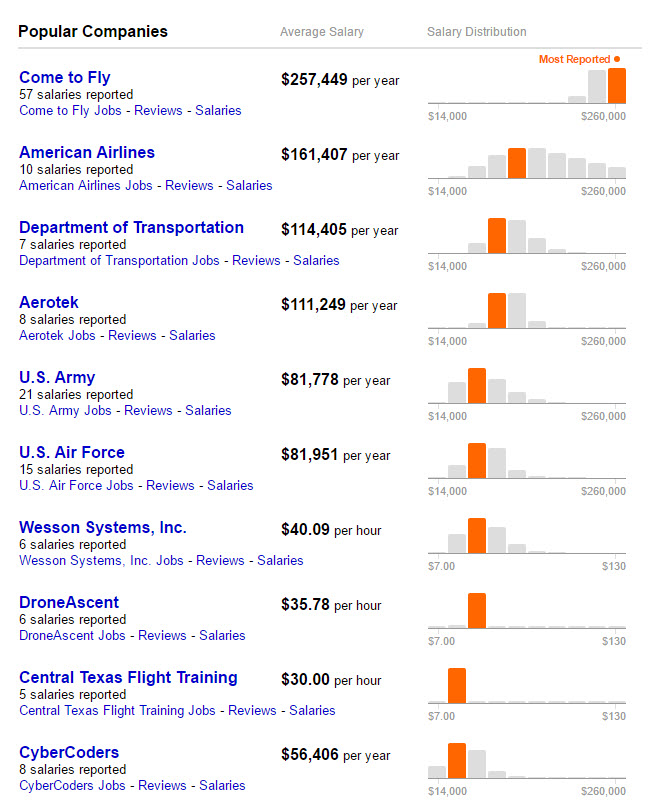
The following salary data was prepared by indeed.com and is relevant to the United States of America. The pilot salaries stated are an average of thousands of jobs advertised throughout the country.
Resources
Department of Labor (United States) http://www.dol.gov/index.htm
Bureau of Labor Statistics (United States) http://www.bls.gov/home.htm